Every scene, response and ending is here. In the interactive story, your choices select the responses and the ending.
Opening
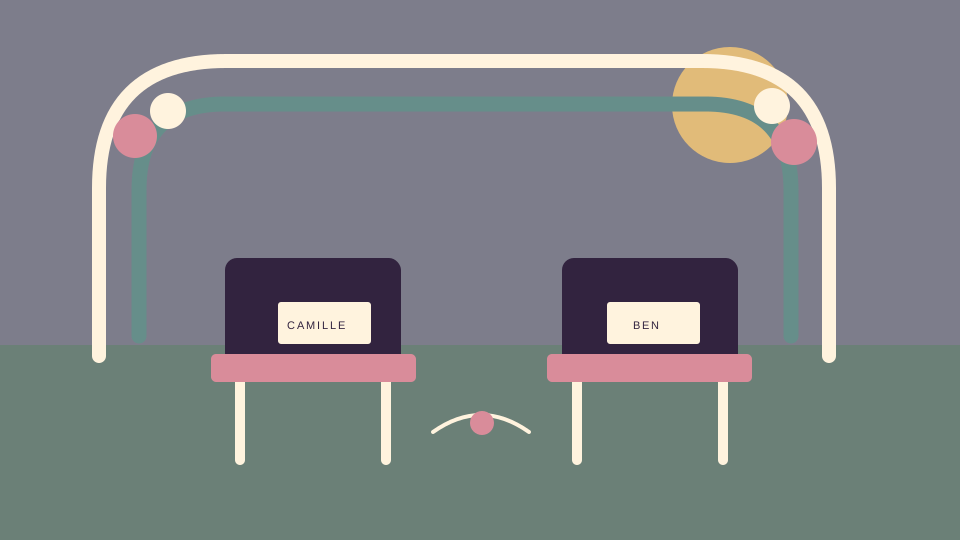
Your name card is tucked beneath a sprig of rosemary. Beside it, Ben's card leans against a water glass as though it has already become tired of standing up.
At thirty, you have attended enough weddings to know that seating arrangements can become a hobby for people with too much access to a spreadsheet. You are Camille, an urban gardener. Ben, thirty-one, has been your friend since the summer you both worked at a badly organised festival.
He arrives carrying a plate of bread. “I remembered you never get fed early enough at these things.”
You take a piece before thanking him. Across the table, Priya announces that putting you together was her finest work. Someone asks whether they should start saving for another wedding.
Ben smiles, but checks your face before joining the joke. The ceremony belongs to your friends. The answer to this question belongs to neither Priya nor the table.
Scene 1
What the table thinks
The garden is full of late sunlight and people finding their seats. Ben moves his chair so you can set down your bag. He has always been considerate in small, practical ways. You are not certain when you started noticing them differently.
Priya raises her glass. “You can't say we didn't try.”
There is affection in the teasing, but also an audience waiting to decide what your reaction means. Ben puts the bread between you like a useful neutral country. You could let a joke stay a joke, or draw a quiet line around the conversation.
How do you answer the teasing?
Option A: Make it clear that any next step belongs to you and Ben.
A little space around the question
“We'll let you know if we need a committee,” you say, smiling. “For now, tell me about the honeymoon.”
Priya laughs and accepts the change of subject. Ben thanks you under his breath. He does not sound rescued from you; he sounds glad to have been rescued from the room.
When the conversation moves on, he asks whether the joke bothered you. “The deciding-for-us part,” you say. “Not sitting here.” His expression softens. The difference has been heard by the person who needed to hear it.
Option B: Share the joke, then check privately that Ben is comfortable.
A joke with an exit
“Only if the committee pays for the cake,” you say. The table laughs, and you let the attention move away before leaning towards Ben.
“Was that all right?” you ask.
“It was,” he says. “Thank you for checking. I wasn't sure whether to laugh or start apologising for the seating chart.”
You tell him he has nothing to apologise for. For a moment, you are simply two old friends making room for each other inside a noisy evening. The joke has not become an agreement.
Scene 2
Beyond the table
After the speeches, you carry two empty glasses towards the garden wall. Ben walks beside you, leaving the dance floor to people who know what to do with it.
He tells you he has accepted a job at a community library. You describe the roof garden you are helping residents plant. You realise how much of your lives has recently been exchanged through group messages.
“I've missed this,” he says.
“The remarkably glamorous glass collection?”
He smiles. “Talking without six people improving the conversation.” You hope he will say more, then wonder whether hoping is the same as knowing what you want.
What carries forward from choice 1
After option A: You moved the table's attention away before the question became a performance. Out here, Ben seems more willing to finish a sentence without checking who is listening.
After option B: You laughed with the table and then checked on him privately. Ben knows the joke was not permission to assume anything about the two of you.
What do you ask or explain?
Option A: Ask whether he has ever wanted to take you on a real date.
A question without a cheering section
“Have you ever thought about us outside the group?” you ask. “As a date, I mean.”
Ben rests the glasses on the wall. “Yes. I didn't want to make our friendship feel like a waiting room for something else.”
You appreciate that sentence enough to think before answering. The question has become real for you too, but the wedding has made everything louder than usual. He does not ask you to turn curiosity into certainty. He asks what you would like to find out when nobody is watching.
Option B: Explain what you value about the friendship before discussing anything new.
Something worth keeping honestly
“I like that I can tell you when my day has been boring,” you say. “I don't want us to lose that because everybody thinks we're missing an obvious plot twist.”
Ben laughs, then grows serious. “I don't want that either. But I also don't want either of us using friendship as a word for something we haven't actually said.”
You agree to speak plainly, even if the answers do not match. Protecting the friendship cannot mean making each person pretend the conversation never happened.
Scene 3
After the last song
Inside, the couple are being photographed beside a slightly collapsing cake. You and Ben return in time to hold the table steady, then retreat before anyone gives you another job.
The evening is almost over. There will be taxis, tomorrow's messages, and the possibility of letting this conversation dissolve into a pleasant memory. You could call it wedding atmosphere and never ask again.
Ben stands beside you at the gate. “We don't have to solve it tonight. But I'd rather not make silence do the solving.”
You can suggest a meeting with a clear purpose, or give an honest answer about the limits you have discovered.
What carries forward from choice 2
After option A: He has admitted that the idea of a date is not new to him. You do not have to match his history of wondering in order to give an honest answer now.
After option B: You both said the friendship deserves an accurate name. That means being kind about a difference, rather than hiding it beneath a familiar routine.
What do you say before leaving?
Option A: Suggest meeting alone next week, with no wedding audience.
A meeting with its own purpose
You suggest coffee on Wednesday and a walk afterwards. “Just us. So we can find out which part of tonight belongs to us and which part belongs to the music.”
Ben checks whether you mean a date or a conversation about one. You are glad he asks. You agree that the meeting will not be a test either person has to pass, and that you will both say what you understand it to be.
You put the time in your calendars. This invitation will not depend on another friend arranging adjacent chairs.
Option B: Name what you can offer without making a wedding-night promise.
The answer you can take home
“I want to be honest about what I can give you,” you say. “Not what would make the best ending to somebody else's evening.”
You talk about affection, expectation, and whether either of you has been quietly hoping the other would make a decision first. The answers are gentle, but not always easy.
You do not offer a date to soften an answer you do not mean. He does not call every uncertainty a rejection. By the time your taxi arrives, the conversation is clearer than the jokes at the table ever were.
Where the choices lead
A is the first option; B is the second. Read the letters from choice 1 to choice 3.
Ending
No Seating Plan Required
“A date,” you say, after giving yourself a moment to mean it. “I'd like Wednesday to be a date.”
Ben's smile is quieter than the grin he wore at the table. He asks whether you would like the cafe near your garden project or somewhere neither of you has been. You choose somewhere new, then immediately argue amiably about which bus reaches it.
On Wednesday, the first few minutes are strange. You know his favourite terrible film and the story behind the scar on his hand. You do not yet know how to take his arm without making a joke of it. You admit this, and he laughs with relief.
The awkwardness does not mean the friendship has vanished. It means that familiar people are doing something unfamiliar by choice. Over coffee, you ask about the library job. He asks about the roof garden without turning the question into a reason to impress you.
After the walk, he asks if he can kiss you. You say yes. There is no table to cheer and no friend collecting evidence for a group message. Later, when Priya asks how your week is going, you tell her it is going well and leave the rest for another day.
A friendship has become a romance without being treated as an incomplete romance all along. You still have boring days to tell each other about. Now there is a different kind of anticipation beside them.
Ending
The Name That Fits
Away from the wedding, you give the question a clear answer: you want the friendship, without asking either person to keep auditioning for a different role.
Ben is thoughtful before agreeing. He says the conversation has helped him separate a genuine possibility from the ease of imagining one. You tell him that affection is real even when it does not become a date. Neither of you has to reduce the evening to a joke in order to move forward.
You spend time together the following week. The setting is ordinary enough to be useful: a cafe, a problem with a bus route, a discussion about whether the cake was supposed to lean. You notice that you are relieved to be there without trying to produce a romantic feeling on schedule.
Later you ask Priya to stop organising your relationship for you. Ben asks the same thing in his own words. She apologises, and gradually learns that two chairs beside each other can simply be two chairs.
There are a few awkward moments. You let them be brief rather than turning them into evidence that honesty ruined something. When Ben calls about the library's new gardening shelf, you talk too long and miss your first bus.
The friendship remains because you have spoken about it, not because you have avoided speaking. It now has a little less guessing inside it, and more room for both of you to meet other people without leaving an unspoken promise behind.
Ending
Different Roads From the Gate
You discover that the question means different things to each of you. Ben has been carrying a hope he cannot simply put back into the shape of the old friendship. You cannot offer romance without pretending a certainty you do not feel.
“Then we shouldn't make each other wait for a different answer,” you say.
He agrees, although agreement does not make the moment painless. You decide to give each other some space after the wedding. You will remain kind at shared gatherings, but stop using familiar late-night calls to maintain a possibility neither can honestly promise.
The taxi ride home feels quieter than you expected. You are sad about something real, even though it was never a relationship. That sadness does not make the conversation unnecessary. It is part of understanding what was there.
Weeks later, you see Ben at the library opening. He asks about the roof garden. You ask about the new job. The exchange is warm and brief, without either of you trying to prove that everything is exactly as it used to be.
You leave to meet another friend for dinner. Ben turns to help a visitor find a book. There may be a different friendship in the future, or there may simply be two people who wish each other well.
Neither future has to be decided at a wedding gate. For now, you have stopped allowing a room full of good intentions to write promises in your names.